Blog

  • About Cucumbers

    About Cucumbers

    English Cucumber vs. Persian Cucumber: An Expert Explains the Difference

    A produce expert teaches us the difference between the two popular cucumbers.

    Trending VideosClose this video player

    0 of 32 secondsVolume 0%

    I love using refreshing cucumbers in salads, quick pickles, sandwiches, and more, and I usually buy whatever looks good or is less expensive at the farmers market or grocery store.

    I know I like English cucumbers and Persian cucumbers because of their thin skin, tiny seeds, juiciness, and sweet flavor, and I have noticed that a lot of recipes call for one or the other. But other than the fact that English cucumbers tend to be long, while the Persian ones are usually petite, what else makes them different?

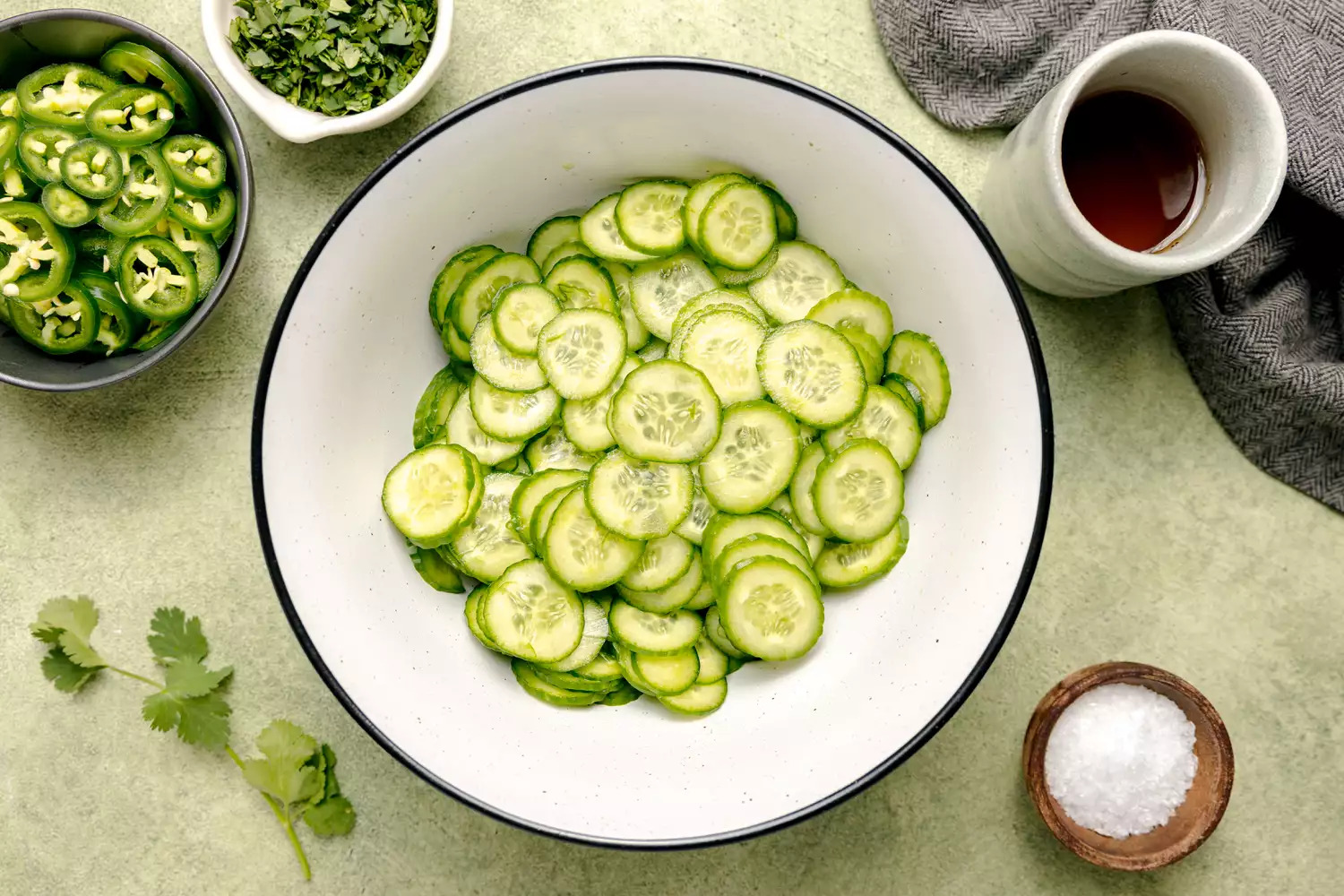
    Sliced Cucumbers in a Bowl Next to Smaller Bowls with Jalapeno Slices, Herbs, and Salt for Spicy Cucumber and Jalapeno Salad
    Simply Recipes

    The Difference Between English and Persian Cucumbers

    “English and Persian cucumbers both belong to the same species—Cucumis Sativus—and exhibit striking similarities while showcasing a few key distinctions,” Bower says.

    “Notably, English cucumbers tend to be larger, averaging around 12 inches in length, while their Persian counterparts are smaller, typically measuring about six inches. In terms of flavor, both varieties share a mild, slightly sweet taste, enhanced by their high-water content that imparts a refreshing mouthfeel and a characteristic crisp bite.”

    What sets both apart from slicing cucumbers—the ones with dark green, thick skin—is their thin skin and very small seeds. “Unlike slicing cucumbers, English cucumbers are thinner and boast tiny, immature seeds that are virtually imperceptible, hence earning the term ‘seedless’,” Bower explains. “Persian cucumbers take it a step further with even fewer seeds, rendering both options exceptionally convenient and easy to digest.”

    While the typical American slicing cucumber has a thick skin that can taste bitter, is often covered with wax, and is best peeled especially when served raw, neither English nor Persian cucumbers need to be peeled. Bower doesn’t recommend peeling them unless a recipe specifically calls for it.

    One way that you can distinguish English cucumbers and Persian cucumbers other than by size is by their packaging at the grocery store. English cucumbers are usually sold individually wrapped in plastic and Persian cucumbers are often found in plastic-wrapped packs of five or six. In my experience,  Persian and English cucumbers are typically about the same price by weight. 

    What Are the Best Uses for English Cucumbers vs. Persian Cucumbers?

    “When comparing Persian and English cucumbers, preference is often dictated by the specific culinary application,” says Bower. For example, he says “something magical happens” when you combine English cucumbers and feta cheese. “The saltiness and subtle tanginess of the feta perfectly complement the refreshing coolness and natural sweetness of the cucumber, resulting in the creation of an iconic dish—the Greek salad.”

    He also loves English cucumbers in creamy salads with dill, as well as a salad his mother-in-law makes with English cucumbers, mustard, vinegar, heavy cream, and salt and pepper. “My five sons absolutely go bonkers for my mother-in-law’s cucumber salad.”

    Because of their shorter length, Persian cucumbers are great for dipping and snacking, says Bowers. “They’re popular among kids for a healthy school lunch alternative,” he adds. He also

    Can You Substitute English Cucumbers for Persian Cucumbers and Vice Versa?

    Yes. “Since both are very similar in taste and texture, they can be used interchangeably,” says Bowers.

    The one time it’s inconvenient to substitute English for Persian cucumbers is when you just need a little cucumber. For example, I prefer to keep Persian cucumbers on hand for my lunchtime salads since I’m usually only making one portion and I can use up a whole cucumber in one go.

    3 Reasons Why English Cucumbers Are Wrapped in Plastic

    Why is it that some cukes roll around sans-packaging, while my beloved staple variety is confined to a plasticky prison? After a bit of research, I’m happy to report there are very good reasons, and even happier to report that companies are working on eco-friendly alternatives to single-use packaging. Read on to learn why the packaging is so important for English cucumbers.

    1. Plastic Wrap Helps Keep Moisture In

    English cucumbers have thin skins. This makes them susceptible to losing moisture as they sit on grocery shelves, transforming them from crisp and snappy to tough and bendy. The plastic wrap provides a second skin to keep moisture sealed inside the cucumber for longer.

    Between cucumbers stored loose in a resealable bag and those wrapped tightly with plastic wrap, the plastic-wrapped veg outlasted the ones in a resealable bag by twice the amount of time—a full 10 days vs. five days! 

    The cucumbers in the resealable plastic bag had room to breathe and release moisture—this created a moist environment ideal for housing microorganisms that cause rot. This was not a problem for the tightly wrapped cucumbers.

    2. Plastic Wrap Prevents Bruises and Scrapes

    An issue with thin-skinned English cucumbers is their propensity to be nicked, scratched, and bruised as they are transported from farm to store. Not only do shoppers prefer unblemished produce, these bumps and scratches can develop mold and rot, one reason why the FDA recommends buying fruit and vegetables that are not bruised or damaged.

    3. Plastic Wrap Keeps Decay-Causing Oxygen Out

    If you’ve ever worked with or around food, there’s a chance that you’ve had to learn the which stands for the six conditions required for the growth of foodborne pathogens.

    The “O” represents oxygen—it accelerates food spoilage as most microorganisms require oxygen to grow and multiply. Oxygen also causes oxidation, which turns the cucumbers brown. Just as the plastic wrap around English cucumbers keeps moisture in, it also keeps oxygen out, therefore slowing the rate of decay.

    The Takeaway

    Persian and English cucumbers are two excellent varieties of cucumbers. They both have small seeds and thin skin, so they don’t need to be peeled. English cucumbers are much wider and longer than Persian cucumbers, but they both have a mild, sweet, and delicious flavor, so feel free to substitute them for each other in any recipe.

  • About Nuts and your health.

    About Nuts and your health.

    One of the BEST snacks

    Before you try, please check your Allergy- very Important. Do not eat any nuts if you are allergic to them.

    A variety of nuts arranged in a circular pattern on a blue background.

    In the world of nuts, pecans have always reigned supreme as a fan favorite. It makes sense: They deliver a delicious flavor and add flare to any dish , they’re really good for your health. Pecans have several key nutrients (including fiber, copper, thiamine, and zinc) and can help improve blood sugar, as well as heart and brain health, per Healthline. And now, thanks to a new study, there’s one more reason to add pecans to your list of best snacks: They could help lower your cholesterol.

    I keep all these nuts in my refrigerator and have about a half a cup of then a day.

    At least, that’s the major takeaway from a new study published in The American Journal of Clinical Nutrition. And since high cholesterol is linked to serious health complications like heart disease and stroke.

  • WHat is MSG?

    WHat is MSG?

    When you hear the initialism MSG, certain connotations and possible red flags are sure to come to mind. This item is also known as Ajinomoto.

    Discovered in Japan in 1908, MSG — monosodium glutamate —, MSG has become one of the most controversial flavor enhancers on the market.

    This additive looks like salt.

    What is MSG?

    MSG was originally used in Asian cultures and is associated with Chinese food.

    “In 1909, the Ajinomoto company was launched to bring this tabletop seasoning to the people of Japan,” Rains tells Yahoo Life. “And for many decades, around the world, MSG was consumed without issue. So in the ’30s and ’40s, the U.S. was one of the top three consumers of MSG globally, and no one had an issue with it. It was used in military rations. The product Accent was released in the mid-1940s, again, as a seasoning for food, and it was consumed without issue.”

  • Why most people in India are Vegetarian but not Vegan.

    Why most people in India are Vegetarian but not Vegan.

    I have been a Vgetarian but NOT a Vegan.

    I grew up in a home on a farm and we always had people tell us( who came to Milk the Cows) that you must Milk the Cows or they will die.

    In recent years I have been learning more about Vegan food and why people are Vegan.
    There are two main reasons:

    • Allergy to Milk and Milk by products and Dairy Products
    • Do not want to eat any Animal By products.

    Being brought up as Vegetarian- we never ate fish, or any kind of meat or even eggs.
    We all had Milk, which was considered healthy. We did not want to harm any animal but milk was considered to be helping Cow. I have grown up having dairy products-milk-yogurt and butter, but no Eggs.

    Below is some information I found-this is just the information – not my opinion.

    “Cows have to be milked.”

    Searching the Internet, I came across conflicting information. Some sources claim that the cows may contract Mastitis, an inflammation of the mammary gland. I also came across several sources that state cows become agitated when not milked. Others still, claim that the teats will eventually just dry up.

    In general, if a milking animal is not milked for an extended period of time(more than 1 or 2 days for a cow giving a normal volume of milk – dairy cows are typically milked two or three times per day), they are likely to become ill and may develop mastitis, which is an inflammation and infection in the udder.There is no reason however that a normally functioning dairy farm would not milk their cattle on a regular schedule. At the end of their lactation (which typically lasts 305 days), when cows are giving a minimal amount of milk, dairymen cease milking them for their “dry period.” This is different from just not milking the cow, which may cause to be sick, because a cow is naturally giving less and less milk, and is “dried off” as sort of a vacation before she has her next calf and begins milking again. Dry periods typically last about 60 days.

    Physical ramifications aside however, this argument is problematic for several reasons. In essence, this argument is saying that if the cows are not milked, they will suffer detrimental effects. Animal use however, is inherently detrimental. Dairy cows in particular, typically only live five to six years before being slaughtered.

    It is important to remember that dairy cows, like all nonhuman animals, are economic commodities. Outside of this system, the cows can live 12 to 15 years, but in the dairy industry, they are only economically viable for a fraction of that time. So if one is concerned with the welfare of dairy cows, then how can one support a system that systematically kills them when they are no longer profitable?

    Furthermore, if dairy cows suffer detrimental effects from not being milked, it is equally important to remember that this is a problem we created on several levels.

    Without our interference, the milk would normally be consumed by their calf. In the dairy industry however, this only happens for a few hours before the calf is separated from the mother. We are concerned with the welfare of the cow and so we justify milking them. At the same time, we fail to recognize that we created the original problem that requires their constant milking.

    We not only created the problem, we created the cow. Between around 1925 and the present, cows have been selectively bred to produce four times as much milk, which now averages around 16,000 pounds a year per cow. If not being milked is painful, it is because we bred them to secrete more milk than they ever would have naturally. Through artificial insemination and other techniques, we currently keep around nine million cows a year. We created beings that by our design require our use. If we truly care about the welfare of the cow, the best way to alleviate their pain is not to milk them, but rather to not continue breeding them.

    Furthermore, looking solely at the dairy producing cow fails to recognize the interconnectedness of the animal agriculture system. If one is buying milk with the belief that they need to be milked and this contributes to the cow’s welfare, one must also recognize that they are condemning a male calf to a beef, or more likely, veal farm. As previously stated, all animals in this system are economic commodities. When that cow stops producing milk, it is slaughtered. When the father of the calf stops producing sperm, it is slaughtered. Their offspring will either end up in the beef, dairy, or veal farm. They all end up in the slaughterhouse. Buying milk creates these other lives, and the cycle never ends.

    Sources:

    http://www.epa.gov/oecaagct/ag101/printdairy.html#life
    http://www.ansi.okstate.edu/breeds/cattle/holstein/